City Income Donuts
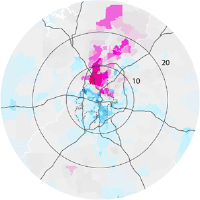 Bill Rankin’s latest project on Radical Cartography is called City Income Donuts:
These maps show the distribution of income (per capita) around the 25 largest metropolitan areas in the U.S. (all those with population greater than 2,000,000). The goal was to test the “donut” hypothesis — the idea that a city will create concentric rings of wealth and poverty, with the rich both in the suburbs and in the “revitalized” downtown, and the poor stuck in between.
This does seem to have some validity in older cities like Boston, New York, Philadelphia, or Chicago, but in newer cities it is not the case. Instead of donuts, one finds “wedges” of wealth occupying a continuous pie-slice from the center to the periphery.
At right (for example), Atlanta. (This jibes with my own experience: in Winnipeg, all the wealthy neighbourhoods are south and west, with older money closer to the centre.) Via CNet.
See previous entry: Radical Cartography.

Comments
blog comments powered by Disqus