Is the Marquette Map a Hoax?
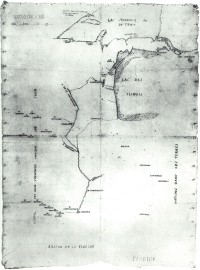
Marquette Map Carl J. Weber, a history professor at DeVry University, argues that a well-known map, purportedly made by Father Jacques Marquette during the 1673 Joliett-Marquette expedition to the Mississippi Valley, is, in fact, a 19th-century forgery meant to bolster Marquette’s place in history as an explorer of the North American interior (at the expense of La Salle).

Weber collects the evidence for his claim, along with a conference paper, on his eponymous web site. His argument can be summarized thusly:

The evidence for the theory that the Marquette Autograph Map is not authentic is based on three considerations: (1) the course of the Illinois River is too accurate for the time it was supposed to have been drawn, (2) Marquette is not known to have received training in cartography, and (3) there is no other map purported to be Marquette’s in existence.

The question is not whether Joliett and Marquette reached the Mississippi, only that this map cannot, Weber argues, be attributed to Marquette or to the 17th century.

CanWest News Service (the wire service for a number of Canadian newspapers) covered this story back in June; I don’t know how I missed it. See also the Museum of Hoaxes. Via MapHist.

Posted on Friday, October 20, 2006 at 9:14 AM
Categories: Hoaxes & Controversies

Comments

Hi,

Should anyone be curious about the core of a presentation on this subject I made recently,
go to…
http://carljweber.com/MarquetteMapHoax.doc

Carl J. Weber

It was a simple glaring fact to all at the Illinois history conference that Mr Weber is incapable of dealing with the many questions that his thesis brings up. The proof was in the pudding. There is nothing to this but Mr Weber’s feverish imagination and equally feverish incapacities. There is nothing more to say about this topic. The story is over. Les jeux sonts faits. Mr Weber loses. Let us now move on to his
“Ellington Stone” ridiculousness. And after that has been put to rest, what will come next? Marie Antoinette discovered the Mississippi? Governor Frontenac was the illigitimate son of Mersenne?
2 +2 =5. Whatever Mr. Weber’s new exploits, the historian community will continue to be amused. No doubt about that. Comedic relief is, of course, a good thing to have around these rather dark days.

(How come my last comment wasn’t put up here… was it my error)
Mr. McCafferty (and his team) continues his style of ad homonym argumentation on this and another blog. He says the discussion of the Marquette Map is over, and I lose. Not so. He does not make the rules. He could easily settle the question of the map’s authenticity by initiating a forensic examination. This challenge goes unanswered by Mr. McCafferty and his team.

Note that Emile Laroche above did not answer my simple request about the “St. Ignace markers,” that a ten-year-old would understand. I’m waiting, and am seriously interested in what this is about. This is not unreasonable to ask for. Note far above that Emma’s request for a proper CITATION in Campeau (the “ultimate scholar” on the matter) has gone unanswered – instead, Mr. McCafferty sent her, offline, a package of smut-level derision about me, that, sopposedly, scholars sent to him. I apologize for having to bring this up.

Also, if the fellow at the history conference who was so “rude” to me (as his actions were characterized by someone who was at the conference) wants to “debate me anytime and place,” as he angrily yelled as I rushed out the door to catch my train – that LAST TRAIN OF THE DAY (dispite Mr. McCafferty’s team’s claim there were later trains) — the fellow might speak for himself instead of using Mr. McCafferty (who wasn’t there) as a stand in.

For those of you who are seriously interested in the history-of-cartography substance of my argument, note what some authorities reflected on my work. 1.) When I gave my talk at the Newberry Library, before the Chicago Map Society last year, Mr. Robert Karrow, curator of the map collection at the Newberry, said that he had had some room for doubt about the map’s authenticity because of the way the lettering appeared on the map. He also pointed out to me that when he put the map exhibit up at my talk, at the Chicago Map Society, that he put quotes around the words, so it read “Marquette Map,” Mr. Karrow pointing out to me the quotes he put there to draw attention to the dubious nature of the authenticity of the map. 2.) David Buisseret, working on the Oxford University Press History of Cartography, and known to all map experts, has voiced no criticisms of my work. Very recently he thanked me for keeping him in the loop, and he had asked me to speak at the 2007 convention of his group, Society for the History of Discovery (see their site http://www.sochistdisc.org/). 3.) The Jesuit magazine editor, in discussing with me the Marquette map (Marquette was a Jesuit) referred to my discovery as raising a “mystery.” 4.) Tony Campbell, known to all in the cartography world, was not dismissive of my claim (google “maphist,” then go to archives, go to June 2006, search page for word “Marquette.” I DO NOT EXPECT ANY OF THESE AUTHORITIES TO SAY UNEQUIVOCALY THAT I AM RIGHT, HOWEVER, I HAVE NO DOUBT THAT THEY would not view as unwelcome an effort by Mr. McCafferty to initiate a forensic test on the map. Mr. McCafferty has not responded to my challenge on maphist – where the experts are – for an effort to help clear this up with a forensic test.

The argument against the fact that scores and scores of maps never got the shape of the Illinois River right, until 139 years after Marquette (1673-4) supposedly got it right, is, in my opinion, at face value untenable. (This map, supposed to have been by Marquette, was never known to historians before 1844). Mr. McCafferty’s team says, “Marquette ascended the Illinois River in a canoe in the late summer of 1673, with Louis Jolliet, a very capable voyageur. The directions that the Illinois River takes are not hard to plot. This is a simple matter. 2+2=4.” Case closed. Not really Mr. McCafferty — If my Aristotelian syllogism is correct, scores and scores of cartographers after Marquette could not do 2+2. What about Marquette being learnèd? I have no motive to disparage him, nonetheless, those who have studied his life know that his superiors, when he was in school, regarded him as a mediocre student. The ACTUAL state of Jesuit map making ability a decade after the Marquette map was supposed to have been drawn is seen at http://carljweber.com/Raffeix.htm. It is a far cry from 2+2=4.

Automated filters work in mysterious ways. All comments in the queue on this subject are now posted.

Well, here we go again. Haha. This would be fun if the matter in question wasn’t so pathetic.

Let’s begin by saying that it’s not my responsibility to prove anything. The burden of proof rests entirely on Mr. Carl J. Weber’s shoulders; he’s the one who has dredged up Steck’s old nonsense. So, go prove your case, Mr. Weber. Unfortunately, you can’t.

In truth, Mr. Weber’s ideas, I mean F.B. Steck’s ideas, reveal no evidence. They are not weighty enough and do not have enough bearing on the case to be significant. They are not relevant—what especially comes to mind is his attempt to point people to later historical *bad* maps to prop of his faulty thesis. Mr. Weber is not competent enough to evaluate the material. This last remark is not a “ad hominen” attack. That is just a fact that has been demonstrated simply by his previous “work”. Finally, to claim that there is a hoax requires *physical* or *written* evidence, not just hearsay, not just innuendo, not just a bunch of hunches.

My sense is that Mr. Weber is simply incompetent, nothing more, nothing less. And neither is that an “ad hominen” attack. I have incompetent students, but I trust in their ablities to change. There is a lot of incompetency going around, so it’s nothing out of the ordinary, nothing special, and nothing to get hung up about. As I’ve suggested to Mr. Weber before, if he wants to be a serious “history professor,” he needs to buckle down and do some serious work, not just spend all his time mucking around in untenable conspiracy theories. There are better things to do, and there is plenty of things that need to be done.

As I sit here and chuckle reading Mr. Weber’s diatribe, I do need to say a few things. I have no “team”. And I’m certainly not standing in for anyone. The crack Illinois Country historian, Mark Walcynszki, who attempted to ask Mr. Weber some questions at the history conference, is, obviously, perfectly capable of asking his own questions. Haha.

Now, on occasion, people do point out websites to me and note what they have seen. But in truth, many a website is garbage in my estimation, and I certainly don’t have much respect for people who hide behind them. Mr. Weber needs to come out from behind his websites, publish his “findings,” and then let the chips fall. Any number of historians I work with are more than willing and able to thoroughly crush anything Mr. Weber says. Simple as that.

It should be noted, too, that Bob Karrow at the Newberry is simply a mice, openminded fellow. He and I are friends and communicate fairly often, including recently, and I can assure any reader of this website that Bob doesn’t buy Mr. Weber’s “Marquette Map Hoax” business. If Buisseret doesn’t know what’s going on, he will soon enough. If Mr. Weber presents at the said conference, I’m confident that there will be competent people there to give him a fine “greeting,” so to speak. Although the dozen or so scholars I’ve discussed Mr. Weber’s map ideas with find them ignorant albeit amusing, there are some who are quite interested in doing some serious stomping.

As for the editor of the Jesuit magazine…wow!
(In truth, just another person I will have to contact.)

I have reams of material on hand, and some of it, it is true, was given to me by other scholars (“my team” ;-). They have followed Weber’s various meanderings (I don’t). This material consistently and masterly refutes *every one* of Weber’s ideas point by point. (This material is just waiting for the time when Weber gets around to actually publishing his ideas, and I certainly have no intention of sharing these with him in order to satisfy his curiosity.) However, in closing, allow me to briefly say that the Jesuit map of 1675 depends heavily, in terms of both hydrology and onomastics, on Marquette’s map of 1673.

I guess it might be a good thing at this point, too, to direct David Buisseret and some Canadian journalist to these websites. They might get to know Weber’s thoughts as only we few lucky ones do.

Michael McCafferty
Indiana University

If anyone is interested in what *really* transpired at the Illinois histoire Conference, check out

http://www.museumofhoaxes.com/hoax/weblog/comments/4211/

Go to page 2.

Just so that people don’t miss things, since comments are going strong at both threads, I posted a followup entry, which also linked to Alain’s URL, last week.

Keep the discussion going (at one or the other or both entries), but please keep things from going over the line.

ALAIN recently said:

If anyone is interested in what *really* transpired at the Illinois histoire Conference, check out http://www.museumofhoaxes.com/hoax/weblog/comments/4211/
>>
Alain does not claim to have been there, unless I overlooked his mentioning it. Was ANYONE who is on the anti-weber team at the Conference on Illinois History?

Please go to the link just above given by Jonathan Crowe, Nov 9, for some material by someone who WAS at the conference.


Mr. Weber,

It is only responsible on you to reveal the name of this history professor, as he needs to be informed of various of your errors before he publishes his piece on the payiihsa, etc. You have led him *hideously* astray.

For the record, all, I am not in any “camp”.

Sylvie Lavigne
Sorbonne
lavignesylv@hotmail.com

Well, so much for name, er, initial dropping; now, back to the matter at hand.

I telephone Dr. McCafferty yesterday and we had a wonderful talk. I was again very impressed by his knowledge of cartography and especially about Father Marquette’s map. He knows this material inside out. I realise he’s no longer participating in these discussion in these blogsites, and, as we who have followed this know, has stated that he is no longer unwilling to help Mr. Weber, he did not tell me that I couldn’t talk about some of the things we discussed on the telephone.

First of all, his knowledge of Marquette’s map is astounding. He knows details about it that no one has ever mentioned, and which are relevant to this discussion. He said that he is not sure if he has already published some of the facts about these details or not, but that they will be out in a forthcoming book of him. The two things that I remember are

1) Marquette marked on his map the rapids at the mouth of the Wisconsin river and the Keokuk rapids at the mouth of the Des Moines River. No French Jesuit returning to North America, i.e., Father Martin, in the mid-1800s would have known such a detailed fact about the Missisipi. The rapids are not mentioned in the Jesuit Relations or any other known Jesuit writing.

2) McCafferty noted that an important archaeological identification of the Peoria village site that Marquette and Jolliet visited near the summer solstice of June 1673 on the Des Moines River would not have been possible without Marquette’s map.

In addition, in respect with other matters that have been discussed on this or the other blogsite, McCafferty said that between 1675 and 1677, Claude Bernou, no friend of the Jesuits as anyone knows, sent three questionnaires to New France to find out more about the voyage of discovery of 1673. In two of the questionnaires, Marquette and Jolliet are mentioned specifiquely. Frontenac naturally would have reviewed these questionnaires, and we know that he expressed no problem with them. Moreover, Frontenac in the spring of 1673 would have read the published Jesuit Relations from the previous two years in which Marquette is mentioned as the one to be going down the Missisipi. Frontenac would have had cow about this if he did not know that Marquette was going on the trip, since he had only recently proclaimated that everyone had to have a passport to go in the West. There was never any problem with this matter chez Frontenac.

Finally, Dr. McCafferty mentioned that there is an autograph letter from Marquette to Father Oliva dated 31-05-1666 in the Jesuit archives in Rome that offers conclusive proof as to the holographic nature of Marquette’s second journal and of his Missisipi valley map. He also mentioned in passing a wonderful coup by Campeau who demonstrated that the Missisipi trip narrative was Marquette’s and not Dablon’s invention by way of analysing the writing styles of the two men. Fantastique! Absolument. He also mentioned that Dablon expressed to Jolliet his pleasure that Frontenac and Talon had agread to Marquette’s going on the trip as Jolliet’s partner. This is in the Jesuit Relations. (But I imagine that Mr. Webers dismisses the Jesuit Relations as Jesuit subterfuge. Oh, well. Little does that matter.)

Sylvie Lavigne
Doctorant
Sorbonne

Je suis desole:

I intended to add that McCafferty also mentioned linguistic facts about Father Marquette’s map, about certain terms on the map, that only Marquette would have known, and especially not a mid-19th century Jesuit coming from France to North America for the first time. There would be no way for such a new arrival to come up with such terms. Thesee are specifically items from the Illinois-Miami language on the map that only Marquette, as a student of the language, would have known. Dr. McCafferty ran through these items but I was not able to write them down. However, if anyone is interested in communcating with him, he did give me his email address, which is mmccaffe@indiana.edu

Cheers,

S. Lavigne

Merci, Sylvie, de tous vos renseignements. C’est tres interessant. Il va sans dire que tout le monde reconnait que le pauvre Mr. Weber n’a aucune chance.

Alain Rocquet


Hi Sylvie,
You say “[Mr. McCafferty] is no longer unwilling
to help Mr. Weber.” I say, this gives an impression that has no standing. I kindly listened to Mr. McCafferty’s lecture-like correspondence, but to say he was my teacher is his own self-estimation.

YOU SAY “there are two things that I remember [Mr. McCafferty told me]” 1.) regarding the rapids, Sylvie, could you point out where these rapids are? Here is the Marquette map http://carljwber.com/MarquetteMapVeryLrg.jpg — I do not see the rapids on the map. Nonetheless, if you can point them out to me, it remains to be said that those rapids were on MANY published maps available in the mid-1800s, and if this Marquette map where made in the mid-1800s, these maps with the rapids on them would have been available – I have seen more than a few. Technically speaking, nothing about the 73-74 expedition would have been mentioned in the Jesuit Relations, because at this Marquette moment, the Jesuit Relations had stopped being published. The state of Jesuit map making knowledge seems to be revealed on http://carljweber.com/RaffeixLarge.jpg. Why wouldn’t this primitave-state Raffeix map have the Marquette detail of the Illinois River on it? That is part of the evidence to be weighed. Why?

2) Regarding the Peoria site, the narrative says it was at the 40th degree of latitude, which places it lower on the River, where the Ellington Stone was found – with the Jesuit Symbol on it. My surmise is that if the Ellington Stone is in fact what it purports to be, it was put where it was found by Jesuit Claude Allouez. Mr. Politsch and I have a friendly disagreement on this – he believes the Ellington Stone is associated with La Salle.
YOU SAID
“McCafferty said that between 1675 and 1677, Claude Bernou, no friend of the Jesuits as anyone knows, sent three questionnaires to New France to find out more about the voyage of discovery of 1673. In two of the questionnaires, Marquette and Jolliet are mentioned specifiquely.” I SAY, I question this. If it is true, I’ll stand corrected. I have, before me, an index of the relevant documents (Guide to the Materials for American History in the Libraries and Archives of Paris) – what is the document reference?? YOU SAID, “Moreover, Frontenac in the spring of 1673 would have read the published Jesuit Relations from the previous two years in which Marquette is mentioned as the one to be going down the Missisipi. Frontenac would have had cow about this if he did not know that Marquette was going on the trip, since he had only recently proclaimated that everyone had to have a passport to go in the West. There was never any problem with this matter chez Frontenac.” I SAY, Frontenac never mentioned Marquette. Please ask Mr. McCafferty where I might find this reference, so I can stand corrected. The closest connection between Frontenac and Marquette is in the opening pages of the Montreal Manuscript, which was “discovered” in 1844. The author made the mistake of saying Frontenac was the governor – it was in fact Courcelles who, with Talon, first chose Jolliet, apparently as recommended by Bishop Laval – who had sent Jolliet to France, perhaps for map making training, but, for me, the purpose of Jolliet’s being sent to Paris is vague.

SL


YOU SAY, “Finally, Dr. McCafferty mentioned that there is an autograph letter
from Marquette to Father Oliva dated 31-05-1666 in the Jesuit archives in
Rome that offers conclusive proof as to the holographic nature of
Marquette’s second journal and of his Missisipi valley map.” I SAY, As I mentioned in a preceding post, I am aware that Gilbert Garrigahn in the 1930s found material in the Roman archives. But, it had nothing to do with what you mentioned. Rather, the material to Oliva, General of the order, consisted of a request, in Latin, that he, Marquette, be sent to, as I remember, China (or Portugal) to missionize. I do not believe Campeau or anyone else considered this document to be holographic evidence. Campeau cites only three examples of Marquette’s handwriting and this is not among them.


I SAY, The reference to Campeau’s analysis of Marquette/Dablon sentence structure – I am familiar with this. Creative, but other evidence, in my opinion, is better suited to analysis. YOU SAID “He [McCafferty]also
mentioned that Dablon expressed to Jolliet his pleasure that Frontenac
and Talon had agread to Marquette’s going on the trip as Jolliet’s partner.
This is in the Jesuit Relations. (But I imagine that Mr. Webers
dismisses the Jesuit Relations as Jesuit subterfuge. Oh, well. Little does that matter.) I SAY, I do not dismiss them as you suggest. They set forth material in the manner suggested by Loyola, in his letters – material for public consumption. I SAY, the agreement you mention was not in the document that was “discovered” in 1844, or anywhere else, and besides, The Jesuit Relations of Thwaites (c. 1900) does not print the 1681 document – Thwaites prints the 1844 document!! – Thwaites even says the 1844 document is in Marquette’s handwriting – nobody else to my knowledge supports this claim.

It sounds like you would like to know the substance of this history. I can give academica-standard citations – that can stand or fall – for my observations. Mr. McCafferty, no doubt has authority in these matters, but you take his word. I’m saying show me. Did you see the letter from the scholar who was at the conference, at which in the written opinion of nobody who was there, was so negative about it?

This will be my last posting and, again, I’m unimpressed with Mr. Weber’s belligerent and self-righteous tone.

I just now communicated for the last time on behalf of this blogsite with McCafferty. I rang him and told him that Weber had posted some questions and challenges. He laughed and then told me that he was expecting my phone call and that he would take a look at what Weber had posted and that he would respond me by email. I just receive his email message and will pass onto all readers a few things. (Alain Rocquet, ecrivez-moi pour avoir des informations additionelles.)

First, McCafferty noted that he had never been Weber’s teacher, but that he had tried to show him a few things a few years ago but to no avail. This was at the time when Weber was in McCafferty’s words “mucking around in Algonquian and French languages but without a clue, and had blasted onto the Algonquian language scene as if he were some sort of expert”. McCafferty allso note that he was extremely offput by Weber’s untoward behavior and all-knowing approach and that Weber reminded him of President Bush. McCafferty described Bush as an insecure bully. He noted that when he realized that there was no way that Weber would listen to anything offered in the way of help, so he just give up.

McCafferty said he was not surprised that Weber in his most recent repost did not bring up the fact that Marquette’s map contains Miami-Illinois language material that only Marquette could have known; in other words, no Jesuit from the 19th century or thereafter would have known those items. Jesuits in the 1800s no longer knew the language or even had access to the Miami-Illinois language data in question. In fact, if you have read McCafferty’s article, published some two years in the >, on the first book ever made in Chicago, Pierre-Francois Pinet’s French/Miami-Illinois dictionary, you will find that the Jesuits could not even identify the language of the dictionary. Once 1763 arrive, once the Jesuits were expeled, once the Britons ransack the Jesuit archives in Quebec and made off with the other two dictionaries of the Miami-Illinois language, that was the end of Jesuit knowledge of Miami-Illinois. The linguistic data on Marquette’s map, along with his cursive script on the map, establishes unequivocally its true nature as a creation of Marquette. McCafferty did note, however, that those linguitic items will “blow Weber’s thesis out of the water”.

Regarding Marquette’s marking of the rapids in the Missisipi, McCafferty said that Weber needs to get a better copy of Marquette’s map and look for himself. The course of the Missisipi is marked with little tiny dots, but the rapids are marked with little horizontal lines. He said he works with an excellent, high-definition, full-size photo of the original map which he bought for $100 at the Jesuit archives in Quebec. :-)

Regarding the Ellington stone, McCafferty note that Allouez had never been near the Des Moines River and that Mr Politsch idea that La Salle was in the area in 1671 is idiotic, revealing an utter lack of knowledge of French-Indian and French-Iroquois trade relations in the 1600s. There was no way the Iroquois were going to let La Salle go “sallying” around in the Ohio valley. Funny word. He added, in passing, that even though Bernou tried to reduce the importance of the Jesuit’s discovery of the middle Missisipi valley, he never question that it had occured, as one can read in the “First Establishment of the Faith”. But in connection with the Des Moines River Peoria site, known today as the “Illiniwek village site,” McCafferty again reiterated the fact that archaeologistes were able to identify that site because of the information that Marquette provided about it on his map.

McCafferty gave me the location and the file numbers and pages for the Bernou questionnaire item noted above. It is in France. On McCafferty’s request, however, I will not share it with Mr Weber. McCafferty said in this connection that “Weber’s ideas have enough rope to hang themselves” and that he would just reserve these items for if Weber ever is able to publish on the Marquette map. He did quote from it, though, for me, and I don’t see any harm in writing this. (He also said the questionnaire was written to Frontenac’s secretary, so Frontenac would have seen it.) It says that Bernou is asking for > (>)

As for Frontenac’s proclamation requiring passports, and the fact that this law was required of missionaries until the king rescinded it in 1675, that is in RAPQ.

Regarding the Marquette autograph letter to Father Oliva, McCafferty has seen an excellent copy of it and it is the exact same handwriting as in Marquette’s second journal and on Marquette’s map. He said that Campeau told him that he didn’t use it because he didn’t need to. Campeau had explained the Boucherville registry entry in a paper in the 1960s and was satisfied. In any event, the letter from Marquette to Oliva is the very same cursive script. And, yes, it is in Latin, but that does not matter one iota. The handwriting is exactly the same. McCafferty sent me a copy of the letter by computer and it is indeed the same handwriting as all of Marquette’s other known handwriting samples.

He also added that the man Weber identifies as J.J. is Jerome Jacobson. He’s not a profeesor. He is a retiree from the Illinois Department of Transportation.

Ok. Good bye to all,

Sylvie Lavigne
Paris

my quote material did not make it to the site. Here it is:

McCafferty’s article in “Proceedings of the Algonquian Conference”

Bernou questionnaire “une relation…avec la carte du R. p. Marquette”.

bon au revoir!

Sylvie gave the citations for the items she mentioned above to me and to Alain Rocquet.

I have a good copy of Marquette’s map and can see exactly the markings of the rapids that McCafferty is talking about. Very nice! Excellent! Wow!!!! This is very cool. Merci, McCafferty! C’est une belle decouvarte.

Although she say that she shall not return to this site, many thanks to Sylvie for pursuing these matter, for talking to Dr. McCafferty, and for sending me the full citations for Bernou, Frontenac, etc. I’m going to be in France next spring and look forward to seeing the Bernou material.

Also, Sylvie send me and M. Roquet digital copy of Marquettes letter to F. Oliva, 1666.

It is also fantastic! Very nice! Beyond question, it is Marquette’s cursive handwriting that we find in his second journal and in his map.

Salut, tous,

S-F Arsenault

I want to add some remarks about the map of Father Raffeix.

According to Winsor, the original map is archived at the Bibliotheque Nationale in Paris. Winsor dates it to 1688 but he also says that this is simply Harisse’s dating. He also says that Kohl places it between the years 1681 and 88.

As Campeau so well explained in the “Cartes relatives a la decouverte…,” Marquette’s map, unfortunately, had little impact on cartography, *even Jesuit cartography* as we see quite well in the Manitoumi maps. The problem is that once Jolliet, with the mapmaker Franquelin’s help, established the incorrect portrayal of the Mississippi, the flow of events in 17th-century cartography left Marquette’s map in the backwaters. As McCafferty pointed out to me last night, and according to Esarey, nobody really knew, even Jesuits like Raffeix, what was right or what was wrong with Marquette’s map once Jolliet and Franquelin started turning out maps. According to Esarey, “Chaos won out.”

Alain Rocquet

Serge, you can see the markings that Mr. McCafferty said were on the map. You say, “I have a good copy of Marquette’s map and can see exactly the markings of the rapids that McCafferty is talking about. Very nice! Excellent! Wow!!!! This is very cool. Merci, McCafferty! C’est une belle decouvarte.”

The cool “decouvarte” is very interesting Serge, and it sounds like you are very enthusiastic about it. Are we talking about the same map? Take a look above the fold at the Marquette Map —http://carljweber.com/MarquetteMapVeryLrg.jpg — These rapids appear on later maps, but where are they on this map?

Once again, Mr. Weber’s tone expresses the heights of arrogance. Here we have a self-anointed “expert” on all things New France, although of dubious
educational and formational background and credentials, some sort of
ex-adjunct faculty member of some technical institute, passing himself
off as a “professor of history,” with no standing anyone is aware of or with any
detectable respect in the academic world, recently humiliated at the Illinois historical
conference, whose work is untouchable in the eyes of refereed academic journal editors,
and who pontificates to the world his “expertise” as if his opinions mattered.

However, Weber certainly knows how to created pretty neat websites.
Gotta hand him that. But, of course, this is the only means by which he
can get his aberrant ideas out into the public arena. So be it. Nobody is impressed.

Has Weber ever once cited Delanglez or Campeau, erstwhile scholars who
went beyond bias and prejudice? Does he just toss out the window the truly
incredible scholarship of these two giants? Does he cite Delanglez’s
work concerning Franquelin and Jolliet. Campeau’s? And whenever the heat
intensifies around him, what does he do? He cries “ad hominen attack!”
when in fact he needs a good course in Delanglez, Campeau and the
ability to read French documents. What we have here in Weber is simply
Father Steck’s reincarnation but worse. But, again, here we have someone whose strategy
is to not respond to excellent points, as for example those made by Lavigne the other
day. Zero for responsiveness. Why?

Mr. Weber has an agenda. He’s a huckster, a hawker, with an agenda to
push. No one should be confused about this at all. He has an agenda, a set of
preconceived ideas that he intends to foist onto the public, the devil
be damned. Mr. Weber skirts around any discussion of evidence that might show
the emperor is wearing no clothes, hoping that readers will not notice
or remember.

Weber’s approach is this: “Here’s what I believe. Here’s what I’ll *choose* to present to you concerning my beliefs. Anything you say is
irrelevant, inferential and sub-primary-documentary, and of course wrong.” End of story.

This website has sufficiently satisfied my curiosity and that of many folks I have shown it to. It’s beyond any reasonable doubt that Marquette’s map was done by Marquette.

On behalf of these people, I will offer thanks to Lavigne, Rocquet, McCafferty, Esarey and all who have devoted their time to helping us see
through these matters, and my “no thanks” to Weber for his useless ideas. The continued ignorance of his proclamations have encouraged me
to sign off.

But to end on a positive note, I did check out what appears to be Weber’s only chance at historical recognition, which is the Griffon
thing. Someone mentioned this earlier. Since it’s clear that he’s not going to convince anyone except the errant misidentified “professor”, the occassional unsuspecting publishers of Jesuit magazines, some unsuspecting journalists here and there concerning anything having to do with Marquette; he should concentrate his efforts on researching and laying out the particulars concerning the Griffon. In fact, an indepth paper on that topic by Weber, despite his lack of credentials and his lack of credibility in other topics, would probably make it into a refereed journal.

Ok. Time for me, too, to check out from this truly weird website.

Bonne journee a` tous,


Yvette Bertrand
Ste-Agathe-des-Monts
P.Q.

This entry is more than 30 days old and is closed to new comments.

Comments on all entries are available via RSS.